clinical thought piece
The Hidden Pattern Shaping Modern Resilience
A unified framework revealing the structural–neurological shifts altering how bodies respond, recover, and reorganize
Modern physiology is changing in ways most trainings never accounted for... and practitioners across disciplines have been feeling it long before anyone named it.
Clients describe bodies that feel more compressed, more vigilant, less responsive.
Work lands… but doesn’t hold.
Patterns soften… then tighten again.
Everything slips back too fast.
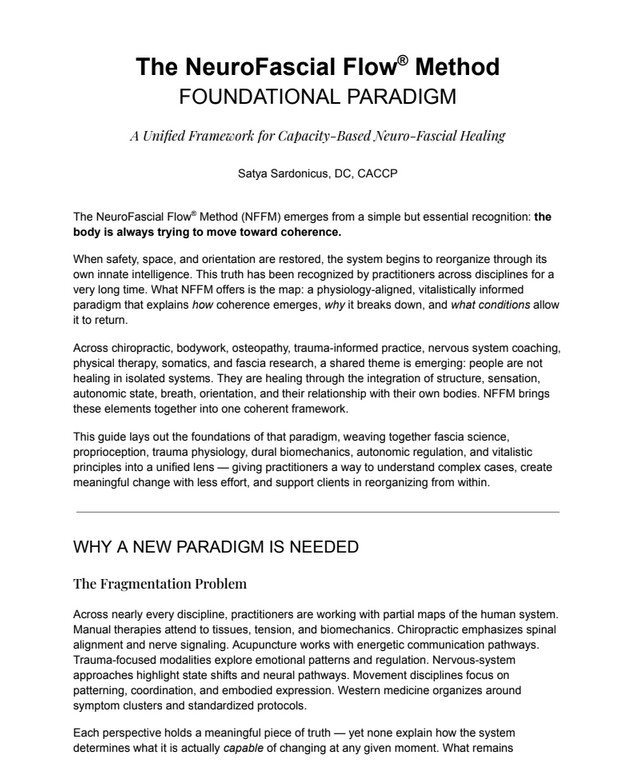
This clinical thought piece explains why, and what actually governs the body’s ability to reorganize.
Get the full PDF delivered to your inbox ⬇️
Why this is resonating with so many practitioners
In a recent conversation with Tom Myers (author of Anatomy Trains), he said something that landed with an unmistakable truth:
“The stress load people are coming in with is accumulating faster than I can shovel it out.”
And clinicians everywhere are naming the same patterns:
→ techniques that used to work beautifully now stall out
→ releases feel good in the moment but don’t hold
→ trauma work integrates unevenly or unpredictably
→ movement retraining hits a ceiling
→ clients feel stuck in patterns you can’t unwind
→ systems feel “buzzy,” braced, or reactive
→ improvements slide backward faster than before
If you’ve been sensing this in your own sessions, you’re not imagining it.
These are the clinical signatures of a system whose capacity is outpaced by load — and they’re showing up across every modality.
The real issue isn’t just that bodies are “more stressed”… it’s that their ability to recalibrate has changed. And almost no one is naming the structural–neurological mechanism that’s amplifying every other dimension of resilience.
This clinical thought piece articulates that mechanism.
Inside, You’ll Learn:
🔹 Why modern bodies are presenting with higher axial load
🔹 How the Dural Fascial Kinetic Chain (DFKC) influences proprioception, autonomic tone, spatial stability, and integration capacity
🔹 Why excellent technique no longer guarantees results
🔹 The neurofascial–autonomic loop that keeps pulling systems back into protection
🔹 The missing dimension linking trauma physiology, fascia, and mechanical adaptability
🔹 Why some systems reorganize beautifully — and others collapse, resist, or dissociate.
This is not another technique.
It is the physiological map that explains what your hands, eyes, and nervous system have already been sensing.
How This Differs From Everything Else

NFFM is not:
• another fascia technique
• another somatic method
• another stand-alone trauma modality
• another neurological drill
• another movement protocol
It is a unified paradigm that explains why so many modalities are suddenly running into the same limits.
Specifically, it maps how structure, sensation, orientation, proprioception, autonomic state, and dural-fascial load interact to determine whether the system can actually recalibrate.
Most approaches treat these as separate issues.
This framework shows how they converge into a single mechanical–neurological bottleneck — one that modern life is overloading constantly.
Practitioners tell me all the time:
“I knew there was something deeper going on, but I didn't have the language for it.”
This clinical thought piece articulates the deeper mechanism many providers have been sensing — but hasn’t yet been clearly mapped in our field.
This is for you if...
• your hands and perception are already discerning
• you’ve noticed more bracing, hypervigilance, or “buzz” in tissue and presence
• you’re excellent at what you do but frustrated by inconsistent integration
• you sense there’s a deeper mechanism beneath your current modalities
• you want a framework that cuts through the overload of fascia + nervous system content online
This was written for practitioners with a strong foundation — those who want a clearer map for what’s happening in modern physiology.
Why Practitioners Are Asking for This
When I shared a small excerpt of this clinical thought piece in a private group, the response was immediate:
Over 400+ practitioners requested the full PDF within 36 hours.
Chiropractors, PTs, LMTs, somatic therapists, movement educators, acupuncturists, naturopaths, and trauma-informed clinicians all said the same thing:
“This puts language to what I’ve been sensing but couldn’t explain — finally!”